

Event-based analysis
The activPAL uses an event-based analysis approach to categorize and quantify physical activities and sedentary/sitting behaviors. Instead of the traditional epoch-based analysis used by many other accelerometers (which aggregates data into fixed time blocks, e.g., 60-second intervals), the activPAL identifies and logs “events” in real-time.
Event-based analysis with the activPAL:
- Posture and Movement Classification: The activPAL employs a thigh-worn inclinometer to provide information about the angle and movement of the thigh and uses this to classify a person’s posture and activity. It continuously monitors this information to identify three primary states:
- Sitting/Lying: The thigh is in a horizontal or near-horizontal position
- Standing: The thigh is in a vertical or near-vertical position, but there’s little to no dynamic movement.
- Stepping: The thigh is in a vertical position with dynamic movement, indicating walking or other stepping activities.
- Event Logging: The activPAL doesn’t simply sum up activity in fixed time chunks. Instead, it creates a time-stamped log of every event or change in posture or activity. For example, it records the exact time a person transitions from sitting to standing, from standing to stepping and then each step in turn (and of course back to sitting again). The log includes the start time, end time, and duration of each period spent in a specific class of activity.
- Detailed Behavioral Patterns: This event-based approach provides a more detailed and nuanced understanding of an individual’s behavior. Researchers use this data to analyze:
- Frequency and duration of events: How many times did a person stand up in a day? What was the average length of a sedentary bout?
- Patterns of accumulation: The event data can reveal if activity is accumulated in long, continuous bouts or in short, fragmented periods. This is particularly important for understanding the health effects of sedentary behavior, as even the same total amount of sitting time can have different health implications depending on how it’s accumulated.
- Postural Transitions: The analysis can quantify the number of transitions between different postures (e.g., sit-to-stand transitions), which is a key metric for physical function and health.
In contrast to epoch-based analysis, which can miss brief changes in activity and may misclassify an entire epoch based on the dominant activity, the activPAL’s event-based method is considered the “gold standard” for measuring sedentary time and postural changes. It provides a more precise, continuous timeline of behavior that is not constrained by artificial time intervals.
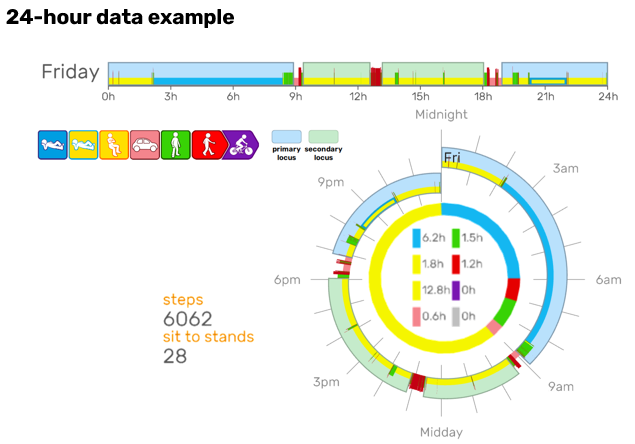
Agnostic data visualisations
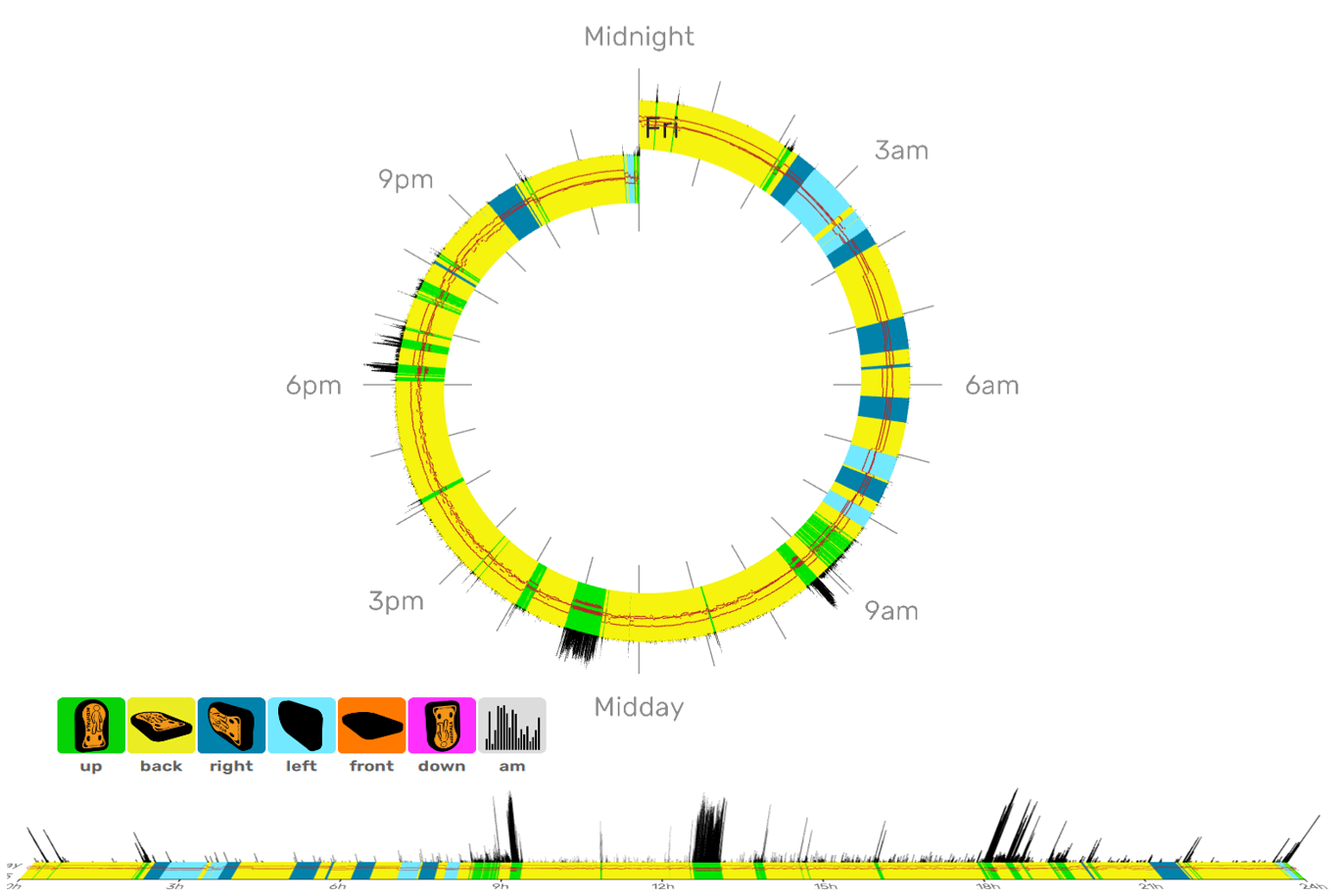
Additional tools
Here you will find a collection of tools and analysis & visualisation suggestions that sit to one side of the standard activPAL Software Suite.
SLICE AND DICE
Individual activPAL Events files can by analysed with Microsoft Excel to
- produce summary data by selectable period (daily/quarter day/hourly)
- aggregate stepping data in bouts with calculation of cadence
- extract event data by activity type
- produce summary of events by sedentary and upright activity
- generate charts to show each day by activity and stepping (by cadence)
https://github.com/PALkitchen/eventanalysis
MIX IT UP
By Processing multiple activPAL events files to generate charts and analysis (for experienced R Users only)